To me, one of the fascinating aspects of this project has been uncovering the language of the South Mountains. I'm so glad I captured a bit of it because unfortunately, it's fading away.
So is the accent. No one I interviewed pronounced words in the old style. Children go to the county fair, not the county "far." Their parents change a flat tire, not a flat "tar." They carry in wood for the fire, not the "far." Wait, bad example. They don't carry wood anymore.
These old pronunciations have been replaced as the generations moved out into society and adapted, without even realizing it. Or as the older generations would say, without even realizing "hit."
But the beauty of the language is still there in the sentence structure and the old sayings. One man who moved into the community as a seven year old sixty years ago remembers laughing at the way people talked, but when I pressed him for examples, he couldn't tell me any. His statement, "I can't tell you because I say them now myself. They have become a part of me."
I did hear a couple from others. Like, raise the winder down. When the coal powered heating system over worked and the classroom became too hot, the teachers opened the windows, raised the winders up. When the room cooled too much, then they raised the winders down.
Going up highway 64. Both directions were up. East, go to Morganton. West, go to Rutherfordton. Either direction, the car would go up the road.
Sort of sad to lose a part of a community that makes it unique from the rest of the world.
Catch of the day,
Gretchen
Saturday, August 18, 2012

Saturday, August 11, 2012
Pilot Mountain
I've mentioned before that there are eight landmarks in North Carolina named Pilot Mountain.
Eight!
I assume way back when the various explorers and pioneers and soldiers were blazing trails through the wilderness, they didn't bother to consult each other as to what names to give landmarks in case one was already taken. They just anointed them with the most convenient, most descriptive name to make directions clear. When a general wanted his men to meet at a particular spot, he'd use a pilot to guide them in a "turn left at the pilot mountain" kind of way. He needed something that stood out, apart, recognizable so that, with no room for errors in judgment, no one would second guess. A pilot. Pilot Mountain.

Eight!
I assume way back when the various explorers and pioneers and soldiers were blazing trails through the wilderness, they didn't bother to consult each other as to what names to give landmarks in case one was already taken. They just anointed them with the most convenient, most descriptive name to make directions clear. When a general wanted his men to meet at a particular spot, he'd use a pilot to guide them in a "turn left at the pilot mountain" kind of way. He needed something that stood out, apart, recognizable so that, with no room for errors in judgment, no one would second guess. A pilot. Pilot Mountain.

Because it stands apart from the South Mountains to its east, this mountain has been
often used as a landmark for travelers. Col. Patrick Ferguson’s 1780 chart of the region
labels it “The Pilot Mountain.”
That's the caption that I wrote to go with the picture of the mountain in the book. What the reader can't see is the chain of mountains to the east, all lined up in a row, like good little children in a class on the way to lunch. All except for this one, this little stubborn mountain that stands alone. It is covered with trees that hide the gashes and gullies carved by gold miners generations ago. Perhaps deep in its bowels lie riches beyond imagining. Gold. Or perhaps, those men of long ago, the ones that moved on to the California Gold Rush, extracted it all, bled the mountain dry before they left.
What a perfect name for a school. Pilot Mountain. They both stand alone, this school, this mountain. They have stories, some told in my book, some hidden in memories too private to share. But some stories, when the moment is right, are there waiting for a storycatcher to find them, pass them along.
That's what this project has been about.
Catch of the day,
Gretchen
Wednesday, August 8, 2012
Captions
So, it's been a while since I've blogged, I just didn't realize how long. But I have been busy doing what writers do, writing, just not here.
My writing this summer consisted more of composing short bits, two to three sentence captions to fit the pictures. The process is not as easy as it sounds.
For example, this photograph was given to the project by Floyd Thomas, the son-in-law of Frank Baker, the man in the picture who donated the land to the county.
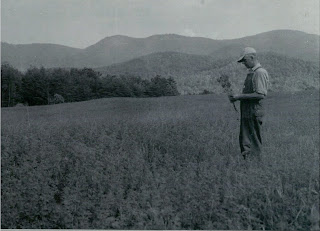 By all accounts, he is standing in the exact spot where the school was built in 1942, based on the mountains in the background and based on the opinions of the many advisors I had looking over my shoulder, discussing it among themselves. (That was a fun day.)
I flirted with several captions, trying them out, seeing what fit best. When the picture location in the final layout ended up being a few pages further into the book, I rewrote yet again. It all seems so simple, this finished caption, maybe even a bit boring, yet it says what needs to be said. Believe me, it is the result of hours of mulling and rearranging.
My writing this summer consisted more of composing short bits, two to three sentence captions to fit the pictures. The process is not as easy as it sounds.
For example, this photograph was given to the project by Floyd Thomas, the son-in-law of Frank Baker, the man in the picture who donated the land to the county.

I flirted with several captions, trying them out, seeing what fit best. When the picture location in the final layout ended up being a few pages further into the book, I rewrote yet again. It all seems so simple, this finished caption, maybe even a bit boring, yet it says what needs to be said. Believe me, it is the result of hours of mulling and rearranging.
Frank and Altha Baker donated a portion of their land for the Pilot Mountain School site. The school would face the South Mountains seen behind him in this undated family photograph.
I'm almost finished with the entire project, only a few odds and ends to tie together, not simple little odds I might add. Then the actual printing.
Then...it...will...be...on...the...market!
Catch of the day,
Gretchen
Wednesday, May 2, 2012
Merlefest and Home Grown Music
Twenty-five years ago music icon Doc Watson created Merlefest, a bluegrass festival that memorializes his beloved son Merle who was killed in a tractor accident not all that far from my house.
Every year for four days, music lovers by the tens of thousands share with each other the love Merle Watson had for bluegrass, country, and just plain old mountain music. They flock from all corners of North Carolina, all states of the union, and countless countries across the seas.
 Can you pick me out in this picture? I was there, listening. Somewhere. And this was only one stage among fourteen possibilities.
One afternoon I sat in the traditional tent listening to Pete Wernick tell about the many jam sessions he had participated in during the festival and how that alone is worth the experience. After all this is not just a listening event. It's also a BYOB festival, Bring Your Own Bass (or guitar or fiddle) and part of the joy is making music with each other.
Just like what I heard doing this project.
Making music and jamming was a part of growing up at Pilot Mountain School. I caught story after story from former students who learned to play guitar or fiddle or bass just being present during jam sessions at the school. One principal who lived there, in the building (that's worth yet another blog post) opened the doors in the evening to men of the community to join him making music. They came in from the fields or the furniture factories or the state hospital, off work, ready to connect. Of course, they didn't label it as that, didn't even consider that what they were doing was powerful.
But it was.
It was so powerful that fifty, sixty years later they remember and speak in hushed, reverent tones, tears in their eyes. Music was in their soul. Music stretches through ages so that in a schoolhouse with a dozen or on a hill with thousands, there is a connection.
We should all seek out the music.
Catch of the day,
Gretchen
Every year for four days, music lovers by the tens of thousands share with each other the love Merle Watson had for bluegrass, country, and just plain old mountain music. They flock from all corners of North Carolina, all states of the union, and countless countries across the seas.

One afternoon I sat in the traditional tent listening to Pete Wernick tell about the many jam sessions he had participated in during the festival and how that alone is worth the experience. After all this is not just a listening event. It's also a BYOB festival, Bring Your Own Bass (or guitar or fiddle) and part of the joy is making music with each other.
Just like what I heard doing this project.
Making music and jamming was a part of growing up at Pilot Mountain School. I caught story after story from former students who learned to play guitar or fiddle or bass just being present during jam sessions at the school. One principal who lived there, in the building (that's worth yet another blog post) opened the doors in the evening to men of the community to join him making music. They came in from the fields or the furniture factories or the state hospital, off work, ready to connect. Of course, they didn't label it as that, didn't even consider that what they were doing was powerful.
But it was.
It was so powerful that fifty, sixty years later they remember and speak in hushed, reverent tones, tears in their eyes. Music was in their soul. Music stretches through ages so that in a schoolhouse with a dozen or on a hill with thousands, there is a connection.
We should all seek out the music.
Catch of the day,
Gretchen
Saturday, March 31, 2012
Author Visit
 This morning I'm going to nearby Lenoir Rhyne University to attend the Afternoon With Lynne Cherry session of the school's Visiting Writer Series. Ms. Cherry is an environmentally conscious writer of children's books. I was thrilled to use two of her picture books in my fourth grade classes and my students were super enthused about their projects based on these books.
 I want to soak up her wisdom. I want to hear from her how and why she created these two wonderful additions to children's literature. I want to talk with her and tell her how my students reacted to her message and the impact her writing made on me as well.
  Pilot Mountain School children were fortunate to meet a fairly reknown author, Bertha Moore McCurry, who wrote under several pen names. She would make author visits to the classrooms and work with the children to improve their writing. I wonder what she said about the how and the why of her writing. But wait, I know the why. She left that answer in a legacy of books, Christian themed books, where her characters lived their faith as examples to follow. Her children's literature series on the three Baers became quite popular back in the fifties. Yes, Baer is spelled correctly, the last name of a set of triplets who got into a variety of sticky situations.
 Both ladies achieved what every writier dreams of: They brought a message that left an impact on their readers. What more could an author want from her writing?
So today, just like the eighth grade students on their graduation day back in 1956 when Bertha McCurry was guest speaker, I will sit back, listen, drink in the words Lynne Cherry speaks. I can't wait.
Catch of the day,
Gretchen
Friday, March 16, 2012
Spelling Lessons
I could use some old fashioned spelling advice right about now as my schoolhouse project is winding down. I'm in the final editing stages and it's not all fun and games. It's tedious and detailed. For example, take the name of an early school in the community. Heavner. Or is it Havener? Or Hevaner? Or, as handwritten on the back of this 1925 class picture, Hevener.
+1925+-+Hevener's+Hump+School.sig.jpg)
Much to my dismay, it's all four, depending on which source I use. Some little man back in the 1920's sat at a meeting taking notes in the school board minutes and guessed at the spelling, quickly jotting down the word, not even considering the problems some obscure author would have almost a century later.
I'm picking the superintendent's spelling - Heavner. I hope he could spell!
Spelling instruction at Pilot Mountain School was by memorization or by phonics, depending the decade and the latest trend. One person I interviewed said she never learned phonics or letter sounds, that she can't to this day, figure out how to spell an unfamiliar word. If she hasn't memorized it, she can't spell it. Another man said the opposite. He learned to spell using letter sounds, made perfect scores on all his weekly spelling tests every year and has the certificates to prove it.
Between the two spellers, there's ten years and a deep division in teaching methods. Why Johnny can't spell? I see why. This project made it clear.
Catch of the day,
Gretchen
+1925+-+Hevener's+Hump+School.sig.jpg)
Much to my dismay, it's all four, depending on which source I use. Some little man back in the 1920's sat at a meeting taking notes in the school board minutes and guessed at the spelling, quickly jotting down the word, not even considering the problems some obscure author would have almost a century later.
I'm picking the superintendent's spelling - Heavner. I hope he could spell!
Spelling instruction at Pilot Mountain School was by memorization or by phonics, depending the decade and the latest trend. One person I interviewed said she never learned phonics or letter sounds, that she can't to this day, figure out how to spell an unfamiliar word. If she hasn't memorized it, she can't spell it. Another man said the opposite. He learned to spell using letter sounds, made perfect scores on all his weekly spelling tests every year and has the certificates to prove it.
Between the two spellers, there's ten years and a deep division in teaching methods. Why Johnny can't spell? I see why. This project made it clear.
Catch of the day,
Gretchen
Friday, February 17, 2012
Play Equipment
As I've worked on this schoolhouse project I've been amazed at the individuals who have stepped up and shared stories with me. Last fall, quite by accident, I met the man who purchased the play equipment when the school closed. It was in his backyard, well used through the years of his children and grandchildren. Would I like to see it?
Would I ever!
My husband and I ventured to his house a couple of weeks ago, camera in my hand, fully intending to take pictures to use in the book. I was underwhelmed, if there is such a word. I don't know what I expected, but this is what I got:
 It was sort of sad, sitting there neglected at the edge of the woods in his back yard. His children have grown and don't want it any more. Their children have grown and the newest generation has much more exciting equipment to occupy their time and energy.
But oh, the memories I've heard about that one little merry-go-round. About girls tucking in their skirts so they wouldn't fly up while they spun around. About pushing and jumping on and going in circles. About wasting time in the mornings watching the buses arrive.
I have found one photo that gives life to this merry-go-round.

This picture was taken the last year of the school's existence, 1972-73. These two students represented Mr. Leonard's homeroom in the junior high homecoming court back when the seventh and eighth graders were considered minature high schoolers... "junior" high schoolers to be more exact. They copied high school activities, even the homecoming concept of queen and court.
Junior highs have faded away now, replaced by the more appropriate middle school structure that recognizes this age group as more than a younger version of the teenage experience. But for those students who came through Pilot Mountain School the three years it was a junior high, this pre-teen experience was a joy to remember. I have seen this joy in their faces. I have heard it in the stories I collected.
And I pass it along to you.
Catch of the day,
Gretchen
Would I ever!
My husband and I ventured to his house a couple of weeks ago, camera in my hand, fully intending to take pictures to use in the book. I was underwhelmed, if there is such a word. I don't know what I expected, but this is what I got:

But oh, the memories I've heard about that one little merry-go-round. About girls tucking in their skirts so they wouldn't fly up while they spun around. About pushing and jumping on and going in circles. About wasting time in the mornings watching the buses arrive.
I have found one photo that gives life to this merry-go-round.

Yes, proof of happiness.
Junior highs have faded away now, replaced by the more appropriate middle school structure that recognizes this age group as more than a younger version of the teenage experience. But for those students who came through Pilot Mountain School the three years it was a junior high, this pre-teen experience was a joy to remember. I have seen this joy in their faces. I have heard it in the stories I collected.
And I pass it along to you.
Catch of the day,
Gretchen
Subscribe to:
Posts (Atom)