Saturday, September 5, 2020

The Foothills

Every writer needs a support group. That's a given, especially for those who are just developing the craft. Let me tell you about one of the groups I belong to that has really stretched my writing abilities. We call ourselves the Foothills Writers. We meet weekly, in person for a year at the library, then by zoom for months and now in the fellowship hall of a local church, spread apart, an eight foot table per person. Yes, we do write, there, on the spot with topics thrown at us by devious prompt finders who snicker as they read the assignment of the week. Six minutes later we share our results. I am humbled at their responses. So creative. So polished. A complete story, plot, characters, dialogue. Six minutes! 

A year ago we self published a booklet filled with examples of our writings. By self published, I mean, Self. Published. As in run off, folded and stapled at one of our meetings.

This year we've had time to investigate a little more about self publishing and have moved up to independently publishing a book through a company. It's still in the works as each of us finish our particular submissions. We chose broad topics like sports, poetry, history, even sci-fi. (yes, me! See what I mean about stretching my writing.) The theme that ties those together is The Foothills with the majority of our entries somehow featuring the Foothills of North Carolina.

At our meeting a couple weeks ago we discussed how we would present the technical term of Foothills to the reader. We want to clarify exactly where on earth we are located. Since I am a former fourth grade teacher who taught North Carolina social studies for years upon years, I was tasked with writing a succinct definition of the Foothills using all our input. Easier said than done.

Fourth grade basic lesson here: North Carolina has three regions, the Appalachian mountains to the west, the Atlantic coastal plain to the east, and sandwiched between them, the Piedmont Plateau. Word derivation is one of my interests, so of course I taught my children a little Italian/Latin background, pied, pie, pede (foot) mont, montium (mountain). We even discussed the connection with the derivation of the word "pedicure." That, my students could relate to. 

In North Carolina the Piedmont Plateau is higher in altitude than the coastal plain and made up of rolling hills leading westward to taller foothills at the base of the Appalachians. The Blue Ridge Escarpment makes a definite cut out of the ancient mountains that clearly shows where the foothills end and the mountains begin. It can be seen in county after county along interstates 40 and 77, mountains in the distance, hills between.  
The Piedmont of the eastern United States
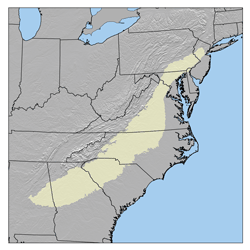
File:Piedmontmap.png
That's a bit TMI for our purposes. We want to show through our writings how hills have influenced the three counties making up our writer's group - Alexander, Caldwell and Burke to be exact. The reader is in for a treat! 
A sample of what our Foothills Writers see every day

I'm still writing and rewriting a definition of the Foothills to go in the introduction of the book. I'll keep you posted as to the progress of the book. Meanwhile in writing as well as in real estate, it's all about one thing:

Location. Location. Location.

Catch of the day, 

Gretchen

Saturday, August 15, 2020

Opportunity to Zoom Along

Like most of us writers, my ability did not just appear out of thin air, or for that matter, out of this heavy, humid, southern air. I had the knack, true, but I soon found knack and desire don't add up to success. I wrote my first short story (beyond weekly spelling assignments!) when I was in third grade, went on to creative writing class in high school, became clerical assistant for the children's lit teacher at Appalachian State University, and during my pregnancy leave of absence, took a writing correspondence class. All this was before I ever submitted a single article for publication. 

I thought I knew writing by then. Wrong. I soon realized writing was not a magic gift from the muse of the day, but rather a developmental process that, in my case, I'm sure tired my muse as much as strained me. I joined a brutal critique group. I attended yearly professional writer's conferences. I worked through CD versions of writing lessons. I repeat: All this before I ever submitted a single article for publication. 

My first article was a long time coming. After years of rejections and rewrites and trash cans and bottom drawers, I was published in Highlights for Children in 2009, and then BAM, POW, WOW, things began happening. Since then, my work's been published in magazines, newspapers and online, in addition to four children's picture books and eight narrative nonfiction books featuring the western North Carolina mountain culture.

That last paragraph didn't come easy, believe me. I am still in the process of learning and if you are a writer, you should be, too. Look for opportunities to grow the skill beyond putting ink to paper, or fingers to keyboard, if you prefer. 

Whether you are a seasoned author or a neophyte waiting for your moment in the sun, you (we) need to be honing our abilities in a learning on the job kind of way. Let me tell you about one group of writers that has an online opportunity coming up September 19. While their focus is on writing for children, the lessons learned there will apply to all writers across the board. This is a writer's group whose foundation is on Christ and Christian principles. I've always appreciated their name, Write2Ignite. Imagine if your writing ignites a child into thinking and acting.  What more could a writer want!

Even though meeting for their typical writer's conference is not possible in this CoVid Era, they want to continue sharing and interacting with other authors by holding an online seminar. What an opportunity! This year, rather than being open to those who can travel, they are open to anyone who can sit in front of a computer and join in. September 19. World wide. Wow, God can make lemonade out of lemons.

And, oh, my goodness, look at the name of the leader, Joyce Hostetter. I've read her books and seen them used in classrooms here in the county where I live. I even attended a play based on her book, Blue. She has so much to share with others. Check out this youtube video of Joyce and you'll see what I'm talking about. Here's what they sent me explaining the one day zoom conference:

What to Expect from the Sessions (NOTE: These are linked to Joyce’s blog posts on these topics.)

·         Creating Memorable Characters — Tried and true strategies for creating characters.

·         On Writing Plot: What’s the Problem — Structure and the power of conflict in creating a great plot.

·         View Point and Dialogue— Dialogue that works overtime and strategies for creating an authentic narrator.

At Write2Ignite, we strive to create a constructive schedule of events that will help you increase your knowledge of writing Christian literature for children and young adults. Each of our events is created with you, the writer, in mind. 

Check out this schedule (based on eastern daylight time)

Registration is open now. Click here for something you can take advantage of to up your writing game while being in the goodness of your own space. Enjoy. Learn a lot. Write often.

Catch of the day,

Gretchen


Monday, August 10, 2020

Practicing a Little Garbology

Staying at home during this Covid Era has brought out the best and the worst in people, and my husband and I have seen a bit of both recently. Isolation is not for the human soul, to be sure, and we humans are stretching the limits put on us. Like getting in the car and just driving for no purpose other than getting in the car and out of the house. Like going out for ice cream and forgetting there is a mask on my face. Like walking in the southern heat and humidity.

We began walking last spring and have slacked off since the daily temperatures rose, and since a few outside opportunities came open to take up our time. Sadly, we've held off the daily hike except for Sunday mornings, seven o'clock, when we walk the mile and a half stretch (down and back) of a side road running near our house. As we walk, we pick up trash using what is known as a "standard trash grabber." He walks ahead, grabs the trash with the stick, and I hold open the bag. No physical contact and plenty of sanitizer, I might add.

Here's the picker-upper we use.

Here's the picker-upper we use, and the picker-upper in use!

Through the months, we've noticed people are improving on the courtesy of not throwing litter out the side windows as they drive by our development. Week before last we barely filled one grocery bag. Yesterday, however, was a different story. Here's just one bag:

I'm a story catcher. What I don't hear first hand, I imagine. So as we pick up some trash, I can't help but wonder what the story is behind it being tossed away. Mostly I attribute an item's presence to lack of intelligence, caring or civic duty on the part of the litterbug. 

Other items, I'm not sure I really want to learn the story behind, like this empty bottle of lice elimination.

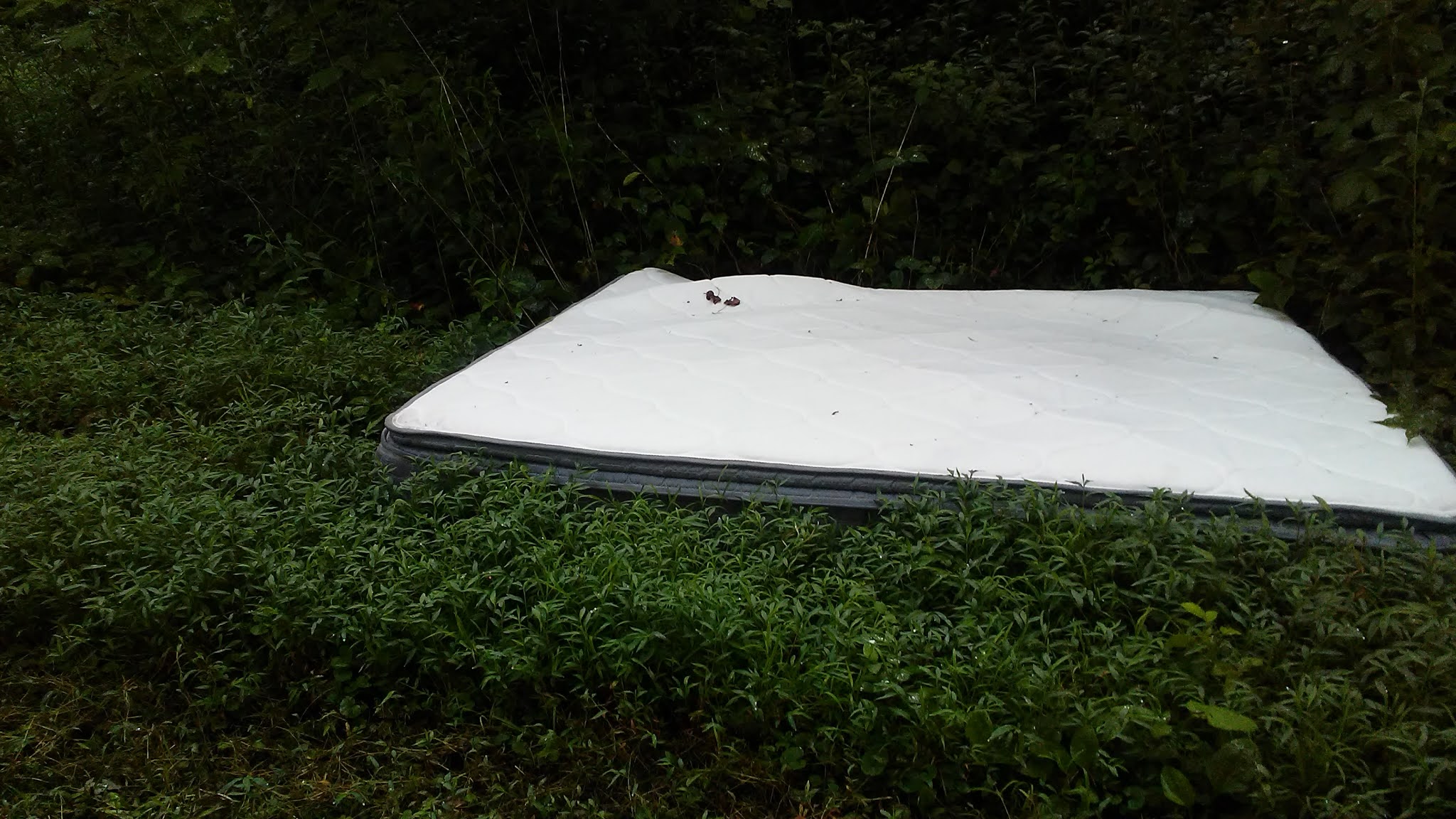
Or why this mattress was on the side of the road, no we didn't pick it up. So when the people arrived at the destination, were they shocked to find no mattress on the roof of the car? What would they do, drive back looking for it, or go buy another? Or were they just too lazy or thoughtless to drive to the dump in the first place?


Which leads us to begin questioning the story behind other castaways. The nearly full bottles of beer. What's up with that, a policeman on the bumper? The fast food litter. Where's the sense of responsibility? The cigarette butts. No comment.

An interesting find yesterday was a CD, not that it was an interesting CD. I didn't recognize the artist. Rather that it was the why. Why would a CD fly out the window. Was the passenger tired of hearing the same old songs? Why didn't the driver stop the car and retrieve it? What were they saying to each other? Inquiring minds (and story catchers) want to know.
 

Not fifty feet down the road, we found another CD? Or did we?


Not a CD, it's a mushroom. Nature laughed. It's still there. And so is the white morning glory that fooled us into thinking it was a wadded up napkin.

There is a science to studying trash. Garbology.

This discipline looks at how trash affects the world and all its assorted problems and solutions. It's also a modern archaeology science, studying what people throw away and looking at a civilization through its leftovers and left behinds. 

Trust me, people leave plenty behind. I could sure write a story or two just from what is in the trash we find. 

Catch of the day,

Gretchen